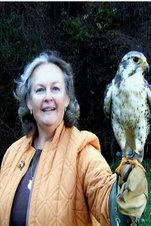
The members of the IWF are impressive in many ways. Sometimes I feel out-of-my-depth as a guest of women with such experience and accomplishment. Perhaps even more remarkable than the level of their worldly achievement, however, is the support they give one another. Beyond networking, there are circles of friendship and affection, even across barriers of geography and culture. (I would add language, except that everyone speaks English.) Given what I have sometimes observed over the years at my husband's law firm, where women are not always supportive of one another, I find the atmosphere at the IWF Conference extraordinary, lovely.
Therefore, it seems to me all the more revealing that the one talent, by and large, these women have not mastered is the art of listening. Of course, this is a broad generalization, one which I am presuming to apply to a group of whose membership I have met only a few; nevertheless, much of the IWF performance during the question-and-answer sessions would seem to support my view. As my two previous blogs have shown, too often an IWF-er takes the mike and, rather than ask a question of the panel, states her own opinion, and states it as if the guest speakers have not just offered us a wealth of new information and possibility from the depth of their knowledge and/or personal experience of Islam and the Middle East.
This platforming, as I call it, says a lot about Americans and other westerners. Although there is a general acknowledgement that we are here in Jordan to learn, that vow is hard to keep. "We know best." It would seem that it is hard for women of the western world to sustain the thought that perhaps we do not.
Because we peer through the viewfinder of our own culture, when we travel we move like snails, carrying with us houses full of assumptions and views. We travel, however widely, protected by an invisible shell of presumptions we don't realize surround us. Of course, this is true of everyone, not just Americans and (certainly) Europeans. It is hard to stop and reflect: what am I looking at? what am I really seeing? Nevertheless, I expected more inquiring minds among the IWF. I am dismayed by the lack of humility--indeed the underlying arrogance. Good listening is a rare gift, but one I had thought to find frequently among the successful women at the conference. (Interestingly, the one good listener I have met is Fernanda, a radio and television personality described to me by her friend Paula as "the Oprah Winfrey of Mexico.") The lack of a spirit of inquiry is all the more appalling because few of the women have read any of the books about Islam and the Middle East on the conference reading list.
These underlying attitudes, and the platforming they provoke, lend the session-side of the conference its final note. Our last panel, because they are last, because they speak during lunch, are given cursory attention. In fact, the ballroom slowly empties as the session unfolds. The lunchers who leave miss at least two intriguing and revealing scenes. The first moment of particular interest is the response of the Jordanian panelists (Marjorie Adams of the Jordan Business Alliance and Reem Badran, CEO of the Kuwaiti Jordanian Holding Company) and the moderator Suhair Al-Ali, a Jordanian government minister, to a question about the one million Iraqi refugees now in Jordan. All three women carefully refer to "our Iraqi visitors." There is only one slip of the tongue--repeating the questioner's word refugee--and that is quickly corrected. Since I had read on the internet several U.N. and Human Rights Watch reports about Iraqis in Jordan, I know that Jordan has been refusing to acknowledge the Iraqis' refugee status. To do so would mean complying with U.N. standards on rights and services that must be given to refugees.
The other interesting moment is a question from a Jordanian IWF-er to the third panelist, Patrick Renauld, EU ambassador to Jordan, about the possibility for a free trade agreement, like the one Jordan has with the U.S., between Jordan and the European Union. The Jordanian woman uses Jordanian textiles as an example. With Gallic hauteur, Mr. Renauld replies, "we are not ready to agree with [to import] bad products." Whoa! French toile de jouy is fine--but as a justification for rudeness? Once again, the Jordanians take it on the chin.
And then the final note: an American IWF-er rises to speak about the Most Important Thing of All, preserving the planet. She mentions the dust storms of a few days ago and lectures the Jordanian panelists about keeping nature in mind. Once again, our hostesses reply politely to western effrontery and ignorance. If the American IWF-er had been reading the local newspaper the last few days, she would have learned: the Khamsini phenomenon, named from the Arabic word for fifty, brings dusty weather to the eastern Mediterranean every year; an Arab environmental conference is taking place in Amman at the same time as the IWF conference; the Jordanian forestry department has begun a five-year plan to plant 6 million trees; Jordan is taking the lead in restoring the marshlands in Iraq that Saddam Hussein destroyed years before. Indeed, if the American IWF-er had not assumed that, as a westerner, she was out in front on green issues, she might have done some inquiring first and learned that Jordan is one of the lowest carbon emitters among nations.
Despite this embarrassing moment, and the other instances of platforming, there have been intelligent questions during the conference, too--particularly from the Canadians. I don't know why it is that the women from Toronto shine--that almost alone they are direct, succinct, and curious--but they are. (Suddenly, Toronto seems like a cool city that I would like to visit.) After the first session yesterday, I complimented a young Canadian IWF-er I had briefly met before. "Good question! Articulate! To the point!" Her companion laughed and said, "we are Jam-AI-cans! In Jamaica, we have a word for it. Spoke-ified! And that's what she is," the Toronto lawyer, originally from Jamaica, said, hugging her colleague, "spoke-ified!"
Saturday, May 19, 2007
Friday, May 18, 2007
Dialogue and Confrontation Continue
The next conference session will be the best, I think, because Leila Ahmed will speak. Among the books on the conference reading list, I have learned the most from Dr. Ahmed's, both her scholarly work Women and Gender in Islam and her memoir A Border Passage, about growing up in Egypt in the 1940's. The session is primed because Queen Rania decides to stay for it. Again we ladies crowd behind the cordon of security guards, holding a path through the ballroom. Flash, flash, flash! the digital cameras click. The fireworks have just begun.
This session is called Myths, Misperceptions, and Realities. The Irish moderator is Gemma Hussey, director of the European Women's Foundation. The four women panelists: Dr. Laila Abu Hassan, chairperson, department of physics, University of Jordan; Dr. Katerina Dalacoura, expert on international relations and the Middle East, from the London School of Economics; Dr. Rima Khalaf Huaidi, chairperson, Advisory Board of the Arab Human Development Report, chairperson of the UN Global Democracy Fund Advisory Board; trustee of the American University of Beirut; Dr. Leila Ahmed, Victor S. Thomas professor of divinity at Harvard Divinity School.
Briskly, Gemma begins with a question to Dr. Abu Hassan on Arab women in science. Dr. Hassan's reply isn't much different from what an American academic might say: the number of women as students and as faculty in physics is growing but still men predominate. Gemma next asks Rima Huaidi about gender ineqality in the Middle East--again a broad question, and really I feel I could answer it myself after all the reading I have done. Referring us to the Towards the Rise of Women in the Arab World report, Rima Huaidi says that the number one achievement for Arab women has been in education. She adds that "Arab girls are the better learners [than boys]." A murmur passes among the ballroom's round tables, for the same thing is true in the U.S. Rima goes on to say that Arab countries still have the highest illiteracy rates in the world.
After a few minutes of such general comments, Rima moves to specifics, and at this point the conference session grabs our full attention. There are two kinds of discrimination against women in the Arab world: personal status laws and the fact that nationality can be passed to a child only through the father. Then Rima lists what she calls "some special problems:" the under-utilization of women's capabilities; genital mutilation among African Arabs; no labor laws for foreign domestic workers; and, finally, foreign occupation--by which she means the Israeli occupation of Palestine. Like Nour the young Palestinian earlier, Rima Huaidi zooms in on the Israeli checkpoints. Palestinian women are forced to wait so long at checkpoints that they are delivering babies there. In addition to this humiliation for the mothers, two-thirds of the babies are stillborn, Rima says.
Rima ends with the generalization that "there can be no Renaissance in the Arab world without equality for women." However, she has lost us, for we are back at the checkpoints with the women giving birth.
Trying to move along, Gemma poses a question to Katerina Dalacoura. "What are the biggest misconceptions?"
"I assume you mean in the West," Katerina replies. She goes on to say that there is a strengthening of stereotypes about Arab women. This stereotype is part of the current belief that there is a clash of civilizations going on. "This is a simplistic and pernicious view that only creates tensions," she says. Women--and in particular the matter of the veil--have become the center of the battle of values and norms. "But the stereotyping is not just one way," she adds. "Women in the West have loose morals." "Women in the West have full equality with men." Among the tables, IWF-ers nod. "We are putting people in a box before we know anything about them. . . . but we need an unpacking of reality to see what is really going on, rather than the glossing and embellishing that usually occurs." Unpacking of reality. Dr. Dalacoura is settling into academo-speak, where previous panelists at the conference have lost their non-American listeners, I have learned. (More on that in a later blog.) Nevertheless, she is much easier to follow in person than in her writing. Several of the conferees have mentioned that they could not get into her book on Islam and democracy.
Gemma now poses a question to Leila Ahmed. "What are the prevailing myths about Arab women?"
Leila Ahmed: "Let me begin with a few facts. 1917. Women get the right to vote in the U.K. 1920. USA. 1926. Turkey. 1946. France. 1947. Pakistan. 1963. Afghanistan. 1971. Switzerland. Women prime ministers: '69. Israel. '79. India. '90. Ireland. '91. Bangladesh. '93 Turkey. 2001. Indonesia. 2006. Germany." Dr. Ahmed speaks quickly, and her staccato has me scribbling as fast as I can. (These dates may not be quite right, and I will review them when I return home.)
"Current research does not bear out women being better off in the West than in the East. . . . violence against women, for example, is endemic everywhere." I sense that, for the first time, an academic on a panel discussion here has the audience's full attention.
"In Afghanistan, where the situation is such a product of the Cold War, the suffering burka-clad women pictures in the media, presented without context or explanation, have led westerners to the wrong conclusion that it is Islam that is at fault here. . . . in fact, there has been a rhetorical tsunami on the subject of Islam that has led to the noble goal of rescuing women from Islam. In this way, war on Muslims can come to seem morally right, when westerners think that they are rescuing women. . . . This is part of a revival of the old colonial myths, and like the old colonialism very manipulative."
Dr. Ahmed shakes her head. "It is so hard now [for Arabs]. Arabs are having to cope with hard new realities. But I do have hope. I place my hope--one--in the Arab and Muslim young--and two--in ordinary people in America, who have a receptiveness, not found in the media, despite the media, to hear the Arab side. After 9/11, for example, so many churches welcomed Muslims and churches were packed."
Gemma takes over from Leila Ahmed. Prefacing her question with a brief reference to the peace in northern Ireland, just as Paula did earlier in the morning, Gemma asks, "Can women in this region work for peace?"
"Already!" Rima says. But Katerina Dalacoura disagrees. "I am sceptical of any particular role women can play. It is not initiative [from women] that will make the difference. Women have a more indirect role. A small contribution." Leila Ahmed agrees, and this is not the first time we have heard (1) American academics tell it like it is, in contrast to the quintessential Arab response, in which good manners prevail; (2) the view that the solution is political, from the top down, rather than societal, from the masses up.
Gemma now opens the discussion to questions, with the brisk reminder that we should limit ourselves to questions only. "We can tell our own opinions in other forums."
A Canadian IWF-er rises to ask Dr. Abu Hassan how government and academia can help to get more women into science. As part of her reply, Dr. Hassan says that there are no advanced industries in Jordan, so science graduates must be teachers. (From reading The Jordan Times, I know that King Abdullah has been working on this problem, and, for example, as we women are meeting with the Queen, her husband is hosting the Petra III Conference, with fifty Nobel laureates in attendance at Petra, to oversee grants for scientific research and endeavor in the Middle East.)
An Israeli IWF-er takes the mike and, addressing herself to Dr. Abu Hassan as well, launches into a description of a regional sharing program in high energy physics that she thinks should interest Dr. Hassan. As the woman continues, describing her country's part in the program, Gemma interrupts, telling her to "finish the question."
Despite the condescending tone of the questioner, Dr. Hassan responds politely, even gently, as she says "I am aware." In fact, she is one of the chairs of the acceleration program. She adds, "I am willing to sit down and discuss this with you afterwards."
Now the feisty Nissreen Haram, the young Arab woman we have heard from several times before, takes the mike. (Later I discover that she graduated from Mount Holyoke before returning to Jordan to practice law.) She addresses her question to Leila Ahmed. "What do you say about the fact that Muslim women now are often dismissed as apologists for their faith and culture?"
Leila Ahmed: "You young [Arab] women are taking my ideas far further than I ever did. You are coming up with ideas I never could come up with." Dr. Ahmed is presenting Nissreen Haram with the positive to her negative. "You are going to school in the West, like I did, but then back to school in the East [as my generation did not]. One-fourth to one-third of young Arab women are deeply feminist even though they don't like the term. They are re-interpreting the old texts, re-translating sharia."
An Israeli IWF-er takes the mike. She tells us that she is a physician from Jerusalem, and she wants to respond to the comment about "women giving birth at checkpoints." Perhaps without so intending, she gives us a statement rather than a question, as she avers that "we have babies from the West Bank in our neo-natal ward . . . and [I believe that] medicine and politics don't mix."
Rima Hunaidi waves the physician's comment aside. "Of course. Of course. But that is very different from the way women are treated at checkpoints." As the physician tries to say that such things do not happen, Rima speaks over her, with a firmness I have not heard from a Jordanian before. "I have my information from an Israeli source, and from Human Rights Watch."
After yet another exchange about the media--in this instance an open-ended question about why the media is doing such a poor job in covering what is really going on in the Arab world--Gemma says that the session can take one final question.
An IWF-er from Seattle says that she is "curious about definitions." She goes on to explain that "religion was never discussed in my upbringing." She asks, "How important is religion in daily life?" I take it that she is asking about religion in the Arab world. She goes on to say, "Arab, Muslim, I'm not sure what you mean."
With that Arab politesse I have come to expect, Rima Hunaidi explains, as if this has not been conversational groundwork at the conference for two days, that in fact most Muslims are not Arabs and indeed live outside the Middle East. That not all Arabs are Muslims--that some are Christians--Copts, Orthodox, Catholic, Maronite. (And Protestant, I might add. But that will be a subject for another blog.)
The final question shows me once again that it is easy to sit and attend but hard to absorb what we hear. But I suppose we have to keep at it. As Nissreen Haram told her friend Mohamed, "dialogue is the best way for people to learn." Dialogue is the beginning.


Wednesday, May 16, 2007
Walls and More Walls
In particular focus, in a tizzy for some, the second morning of the conference began inside a cordon of determined, if amused, security guards. Because every women had to be inside the Grand Ballroom of the Grand Hyatt by 8 A.M., we knew that this morning was the day Queen Rania would spend some time with us. Therefore, with polite attention, but perhaps without much anticipation we turned to our first session "The Future of the Arab World." Our panelists sitting politely and with poise on the podium sofas were six young Arabs: Mohamed Al Bashir, a young man off to Georgetown Law School next year; Enas Abu Shasheih, a young woman who works for Netcorps Jordan; Talar Karakashian, a young woman who is an electronics engineer; Nada El Khoury, a female lawyer from Beirut; Nour Kleibo, a Palestinian young man studying business at Birzeit University in the West Bank; and Mariam Al-Musttaf, an Iraqui refugee, former translator in Iraq, and mother of two.
The female moderator, Laith Al-Qasem, a member of the Young Arab Leaders, Jordan and CEO of Arabian Business Consultants for Development, began the questioning. "Enas, why do you wear the hajab?" (Indeed the young businesswoman wears conservative attire and a wrapped headscarf.)
Enas: "I am lucky to be a Muslim lady who can represent Islam in a nice way. . . . The hajab is something that has never stopped me from doing anything." She emphasizes that the headscarf is her choice. (This is a common attitude among young Arab women who choose traditional dress.)
Moderator: "Mariam, what has the toppling of Sadam done for Iraq?"
Mariam: "With Sadam, we knew how to avoid his evil. But now we have no peace and stability." Mariam, who also wears the wrapped headscarf and traditional attire, becomes agitated. "There are increasing orphans and alienated people. The alienated people! . . . a sectarian war now. I insist we get rid of the intruder." Her reply has verged on incoherence, but we all know what she means.
Moderator: "Nour, will there ever be normal relationships with Israel?"
Nour: "We can't be partners when there is shooting every day. . . . I don't have anything against Israelis, but the Israeli government. . . . You have to understand, the wall is destroying us. This is not a virtual wall, like you talk about here [in the conference]. And I have to say that ninety percent of Palestinian youth are against normalization [of relations with Israel]." The young man's disposition is calm, even laid-back.
After asking the young Lebanese lawyer Nada something non-specific about Lebanon, the moderator turns to Talar, a willowy and vivacious young woman in a western-style pants suit.
Moderator: "What is it like to be a Christian Armenian living in an Arab land?"
Talar: "Jordan is home, and that's all I know." She turns to Enas sitting next to her. "Enas is one of my closest friends." Talar goes on to talk about her grandfather's escape from the Armenian genocide (Turkey itself never mentioned) and subsequent settling in Jordan. "I go to church every week. . . . At Christmas, my Muslim friends come caroling with us. At Easter, the children hunt eggs together." (Talking about the session later, many women would come away with a particularly favorable impression of Talar.)
Moderator: "Mohamed, you are off to Georgetown."
Mohamed: "It's time to see an international country that accepts differences. . . . I am going to live the American dream, experience the American freedom. . . . As my friend Nissreen Haram keeps telling me, 'dialogue is the best way for people to learn.' I am looking forward to the dialogue." (Note to readers that Nissreen Haram is the feisty, impassioned and articulate young woman who vented about American women's obsession with sharia the day before.)
Having scratched the surface of familiar if wide territory with her questions, the moderator now opens the questioning to the ladies of the audience. A young woman from Amman takes the mike. "I hear a lot of the victim voice," she says in a tone of reproach.
I am surprised by the comment, for I have not heard any such thing, even from Mariam of Iraq. And with quintessential Arab politeness, the young panelists respond. Enas has been working with the Bedouin of Wadi Rumm. Mohamed, in the disarming mode we have come to expect from him, says that we have to understand that their schooling has not prepared them for speaking before five hundred people [chuckles from audience] and they are not accustomed to putting themselves forward. Nour says, "victimized?--probably." He goes on to mention briefly Seeds for Peace, his organization that brings together young Palestinians and young Israelis. With the last word, the moderator defends her panelists. "You are all pro-active. Or you wouldn't be here."
Now the moderator asks if we ladies would like for her to continue with the questions or open up the questioning further to the floor. We ladies shout for the moderator to continue. Our experience of questions from IWF members has often not been a postive one (and I will have much more to say on this topic in a later blog), so we vociferously try to overrule the woman who begins to test the volume of the microphone. However, the questioner already has the mike.
IWF Member from Israel: "Why are there no Israeli young people on the stage?" There are a few murmurs of approval for the question among the audience, although most of the audience is silent, for the question is immediately followed by a spate of platforming and the statement of personal opinion, instead of the requested questions, to which we frequently have been subjected.
Ignoring the impassioned statement of the Israeli position on the Palestinian Question, the moderator turns to charming Talar with an anodyne remark about women coping in the largely-male field of engineering. Then in a reply to some question from the moderator, Mariam says that she is enrolling her two children in a Christian school in Amman. An indicator of the unreleased tension in the room is the fact that I do not have among my notes the actual question for Mariam that elicits this surprising reply.
In oblique reply to the Israeli IWF-er's political statement, Nada from Beirut says that young Lebanese don't want to listen to what's going on. "We youth--we're sick of t.v. and news and politics." Some of the other panelists agree, including Nour, even though he dispassionately admits, almost in an aside, that "some of my friends are martyrs."
Moderator: "Turning to the issue of globalization, does it contribute to a dilution of national pride, a simplified fabric of life, does it make life more plain and dull."
Nada: "I think it [globalization] helps me find my identity." In her disagreement with the moderator, the young lawyer from Beirut talks about blogs.
Mohamed: "I want to be able to get a McDonald's meal, you know?"
Despite Mohamed's amusing reply, the word martyrs hovers in the Grand Ballroom. Perhaps sensing that she no longer has her audience's complete attention, the moderator addresses the ladies directly.
Moderator: "All of us are speaking in English, for your benefit."
The room at large seems to acknowledge this linguistic largesse, and after a round of replies to the moderator's question about West learning from East, the moderator again opens the questioning to the ladies. Alejandra, a young guest from Mexico City who will begin medical school at Goucher in the fall, takes the mike.
Alejandra: "What do you want from western youth?"
After a series of general comments, it is Nour's turn. He reiterates the distinction he makes between the Israeli people and their government. He says, "I have no problem with Israelis--we are all human." Nour's body language and tone of voice suggest that he is telling the truth. Continuing, desultorily at first, he speaks in more detail about his life and returns to the subject of the Wall.
Nour: "A wall twelve meters long keeps me from visiting my friend who lives one meter away." Nour goes on. "East Jerusalem, it is a prison--and we are separated from Palestinians in other areas. In July a new law goes into effect requiring a permit to go to the West Bank. Already I get up at 4 A.M. to reach school [in the West Bank] at 7:30. Now it will get worse. And I--I even have an Israeli I.D. Other people just have permits."
Nada: "We need to focus more on education. It is the challenge of youth."
The fact that the young Beirut lawyer has turned the question around, focusing not on what Arab youth want but on what they must do, is interesting and revealing. However, the import of her reply is lost on me at the time because the room is growing restive, as if something unheard and unseen, but a presence nevertheless, has entered the room. A young Palestinian IWF Guest steps to the mike and addresses Nour.
Young Palestinian Woman: "Are actions on the ground by Israel showing Palestinians they [Israelis] want peace?"
Nour: "Even if it is not on the news every day, every day people are late to work and school." He cannot let go of the Wall.
In the restive room, Mrs. Brown from New Jersey takes the mike. In a stentorian voice, she launches into the me-me-me-who I am-my views platforming some of us ladies have come to dread. She addresses the panelists, three of whom are Jordanians (four if you now count Mariam the Iraqi refugee), as parties to the conflict under discussion. She does not differentiate, she does not acknowledge that Jordan has a peace treaty with Israel. Surely, she knows as much, but in her haste to make her point she unintentionally insults the Jordanians on the panel. At the end of her speech, however, she asks a good, pointed question.
Mrs. Brown: "Do you want to make peace with Israel? Each of you, yes or no--that's all I want, let's go down the row, yes or no, each of you."
Mohamed's reply is lost in the scattered applause, the swell of conversation as ladies turn to their table companions to exchange comments sotto voce.
Enas: "That is the hardest question I have ever had to answer." She pauses. "I want peace, but the answer is no."
Nada: "Yes."
Talar: "Yes."
Nour: "Conditional yes, with 1967 borders."
Mariam: "Yes." She thinks a minute. "Conditional, with rights."
Trying to absorb the no from the friendly and reasonable young business executive, we ladies turn to hear Paula, an IWF-er from northern Ireland, who incidentally is one of my new friends, or perhaps "friendly acquaintances," I should say.
Paula: "In northern Ireland we worked it out, and in that way, have any of you [panelists] thought about entering a political party?"
The room thrums with bits of conversation. Northern Ireland, good example. What does she know . . . Lebanon . . . Syria. Paula's question has received different responses, East and West. Amid the tension, and with my curiosity to hear what is being said around me, I record none of the replies from the panel except one.
Nour: "Most of my friends are trying to do just that."
The moderator brings the session quickly to a close. Walking to the hall for coffee break, I run into Paula, in tears. Surprised, because Paula has the tough resilience of a seasoned politician, nevertheless, I put my arm around her shoulder. It seems that one of the IWF-ers from the Bahamas verbally laid into Paula as soon as the session ended. Paula does not repeat what the woman said, but she is shaken and cannot quickly recover her composure.
The hall has filled with Jordanian secret service and police, for Queen Rania is about to descend the staircase into the hall outside the Grand Ballroom. We ladies jockey for position, cameras primed. The earlier tension evaporates. Euphoria reigns. The lovely Rania claims us, if just for a moment.
Final note. If in somewhat pedestrian fashion, I have tried to give you a blow-by-blow account of this particular session. One thing only the writers of the books on the reading list for the conference agree: there can be no solution for any Middle Eastern problem without first the return of the West Bank to the Palestinian people. Secondly, the United States must discontinue its unconditional support for Israel. I have been surprised that the Arabs with whom I have spoken understand our underlying good intentions even as they deplore our invasion of Iraq. They know our generosity and idealism and like us for those qualities. Certainly, in Jordan people appreciate our financial aid and our free trade agreement (the U.S has a free trade agreement with only four countries) and have told us conferees that many times. Many of the Arabs here at the conference either attended or teach at the American University of Beirut and the American University in Cairo (both founded by American missionaries in the nineteenth century). In short, the Arabs I have met honor everything Americans have done for them and do not seem hung up on notions of colonialism in the way some of the reading list's authors are. That being said, all is for nothing without the return of the West Bank to the Palestinians.
Questions from Sasha
Returning from Fakhr el-Din with the other guests of the IWF Forum (the IWF-ers themselves dining in Jordanian homes), and having refrained from the hubbly-bubbly after dinner, I find myself alert and with a few minutes to answer some questions I received in an email from Sasha, who is curious about sharia, security, and camels. Sasha apologizes, saying that in the paucity of her early childhood education she had never heard of sharia.
Well, Sasha, let me explain. There are three sources for the Muslim faith: the Qu'ran, the hadith, and the sharia. The Qu'ran is the Islamic holy book, which contains the series of revelations to the Prophet Muhammad from Allah. Muhammad himself was illiterate, so these revelations were written down after his death. The hadith is a series of stories about Muhammad, his life and wisdom. These stories also were collected after Muhammad's death, and part of their authority derives from their authorship among Muhammad's wives and close companions. The sharia is the large and complex system of Islamic law, which was codified by the Abbasid Muslims after they conquered Persia, moved the caliphate from Damascus to Baghdad, and adopted many of the customs of their Persian subjects. These laws became the Islamic legal code during what we call the Middle Ages. Sharia governs every aspect of Muslim life, from commerce to inheritance to marriage.
Now, Sasha, about security. I feel safe, and I now feel foolish that I ever feared to come here. As Zuhair, our guide chez autobus, said to us, "some of your friends and family told you not to come to Jordan, am I right?" And that was true for each of we sixteen. On our second day of travel, we were joined by a lady from New Jersey and her husband. The New Jersey IWF-er said that all the other members of IWF New Jersey had been afraid to come to the Cornerstone Conference. On the other hand, in the interest of full disclosure, I must report that security at the Amman Grand Hyatt is . . . well, let's just say lax. Although there is airport-type screening at the front door, and although there is always a police car in the drive, and although there is a soldier armed with an automatic weapon in the lobby every time someone of prominence is in the hotel, the two back entrances to the hotel (and there may be more, but I have seen two) are unguarded. This was quite a surprise the evening I strolled down the back promenade.
As for camels, I appreciate your apprehension, Sasha, but you need not worry. Camels have a bad reputation that is undeserved, in my opinion. Yes, camels do make a loud and strange sound when they want to complain, but really this bark is worse than their bite. Camels are very nice upon acquaintance. I had a lovely camel ride in Wadi Rumm, and our camel driver sang as he walked along. I suppose I should mention that camels surround themselves (happily, or not, I do not know) with a penumbra of flies. Many flies. Clouds of flies. When we ladies resumed our travels from the Wadi, I looked up the aisle from the back of the bus and saw that each of us had brought along a personal retinue from the insect realm.
Tuesday, May 15, 2007
The Conference Begins
Today the International Women's Forum Cornerstone Conference Building Bridges Breaking Walls, with five hundred women from forty-five countries gathered in Amman, Jordan, began at last. The event actually started last night with a reception at The Citadel, part of the ruins of the old Umayyad palace. Although my new acquaintances and friends and I had been much looking forward to it, the party was a bit of a disappointment, despite the Bedouin tent, the Arab music, and the hundred or so Middle Eastern carpets under our feet. Perhaps we had been affected by "the dread Orientalism" and were therefore expecting something more unusual and exciting than such affairs back home. However, I must report that the reception was nearly the same as any rather boring law firm/business cocktail soiree I have attended in California--the same cold canapes, the same shifting from foot to foot (carpeting over rubble makes treacherous footing) while making small talk--but all without alcohol, in this instance. Perhaps I am being too severe--after all, the view from the hilltop out over Amman was lovely, and in such a low wattage city Venus was amazingly bright on the low horizon. As the president of IWF and the president of IWF-Jordan gave their opening remarks, we heard the muzzein's call to prayer from a mosque on a hill across the city. When I stop to think about it, I wonder why the two women did not wait to speak until prayertime was done (and it is the same time every evening). It was an odd congruence of circumstance. Also, the security presence struck my (perhaps overly-imaginative) mind as paltry. As the full membership of IWF-Jordan stepped onto the podium, a well-aimed stinger missile could have taken out a significant proportion of the movers and shakers among Middle Eastern women. Perhaps I shouldn't mention such a thing--but if you can't say what's on your mind in a blog, where else?
This morning the conference itself began in parallel lackluster, with a particularly fatuous Maya Angelou poem about the "singing river" and the "wise rock." (You have to wonder if Maya has ever spent any time in the wilderness.) However, the morning quickly unfolded in a series of dramatic moments that, to my mind, are a paradigm of the disjunction between the way Muslim women and "liberated" western women see the world. The morning was so exciting that I am blowing off my afternoon bus tour to Madaba (been to Madaba, had enough of bus tours) to send you my impressions.
The first session, which all we women attended, was Islam, Democracy and Modernization, designed to address the question (among others) whether western models of democracy are appropriate for the Muslim world. The key speaker, Dr. Khaled Abou El Fadl, was a no-show; therefore, the husband of Reem Abu Hassan, the president of IWF-Jordan, took his place at the last minute. Initially, I was disappointed, for Dr. El Fadl is one of the few jurists in the world fluent in both Islamic law and American law. The other panelists were Dr. John Voll, professor of Islamic history at Georgetown, and Dr. Samira Al Khawaldeh, chairperson of the English Department at Al Zaytoonah University, Jordan.
Perhaps because I am an American, I thought that the most articulate speaker was Dr. Voll, who gave us more insights than I can repeat here. He talked about how "democracy is not a particular book you pull off the shelf and read the rules for." And certainly as an Islamic scholar he was and surely is sympathetic to a religious world view; in fact, he made a good case for secularism as just another form of religion. He said that secularism has become the conservative establishment, threatened by the increasing questioning of the assumption that secularism is a good thing. "I know better than believers what is best," Dr. Voll said, in describing a secularist's position. But in fact, Dr. Voll pointed out, religion has not disappeared as expected from the modern world, and he spoke a bit about his recent meeting with the Prime Minister of Norway, who is an evangelical Christian.
Then the moderator asked Mr. Hassan, who got a law degree from Harvard and practices law in Amman, about sharia law. Mr. Hassan, an utterly charming and self-deprecating man, replied that one thing distinguishing Islam from other religions is that it is not just a religion but a way of life. "In some interpretations of Islamic law we went astray but in some we hit the target," Mr. Hassan said. He talked about his experience at Harvard, and how it was actually an Infidel professor (many laughs) who encouraged him not to measure either himself or his culture against western models but to try to find the rules appropriate for his own society. Nevertheless, Mr. Hassan said, "we are always being measured against a western model of some sort."
Dr. Khawaldeh spoke last. With the opacity I have discovered from my reading is common in Muslim thought, she said that "Islam means equality and human rights." She averred, as Mr. Hassan had before her, that "everything good is part of Islam." Like many educated women in the Islamic world, she maintained that under sharia women have complete freedom and human rights.
The session opened to questions, and many of the women in the audience were skeptical. Pressed about sharia on women's rights (divorce, child custody, inheritance, etc.), Mr. Hassan self-deprecatingly admitted his ignorance of the details, the finer points of the laws--surprising, to my mind, considering he is a lawyer. Mr. Hassan's justified the Islamic inheritance laws by saying that although a wife may get less than sons, sons (and daughters) always take care of their mothers. The western members of the audience were having none of this paternalism. First a lawyer and then a parliamentarian from Toronto spoke about recent attempts of Muslim immigrants in Canada to get sharia incorporated into Canadian law. "The initiative was resoundingly defeated," the Canadian said. "Did we Canadians make the wrong decision?" Mr. Hassan's reply, in essence, was "yes." He went on to say that in a future attempt, if the Canadian Muslims handle the legislative process with more finesse, likely they will succeed. It was not the content of the sharia laws themselves, Mr. Hassan was saying, but the way they were clumsily introduced into the Canadian legislative process, that was at fault.
Quickly, the questions degenerated into impassioned personal statements. "All religions discriminate against women and we women should forsake them!" (Russian IWF-er) "There should be no religion in government! Democracy can only be secular!" (Mexican IWF-er) And so on, and so on. Finally, Rebecca Solti, an American?Englishwoman? who has lived in Jordan for thirty years, took the mike. In a torrent of testimony on the generosity and integrity of the Arab people, Rebecca spoke on and on and on--clearly, she had not had a chance to express herself before. My new acquaintance from northern Ireland and myself exchanged a remark sotto voce--why do women's meetings always ramble to a close?--it was becoming embarrassing--when Ms. Solti brought us all up short. "Thousands of elderly French people died in that heat wave two summers ago. That would never have happened in Jordan! Here, like elsewhere in the Muslim world, children look in on their parents all the time and take care of them!"
Sharia continued the subject of the day. In my next session, Faith, Identity and Co-Existence, the specific subject was the expression of faith through art and culture. The panelists were Dr. Janet Soskice, a Fellow of Jesus College Cambridge, who has just written a book on St. Catherine's Monastery in the Sinai; Dr. Maria Rosa Menocal, Sterling Professor of the Humanities at Yale and an expert on Islamic Spain; and Dr. Minwer al-Meheid, a Saudi art restorer and architect who spent many years restoring the minbar Saladin brought to Jerusalem and a fanatic broke into thousands of pieces in 1969. As soon as the question part of the session began, two American women immediately launched into questions about sharia laws and women's rights. Nissreen Haram, a young Jordanian woman and lawyer, stood. Exasperated, angry, she shouted "you western women! Dr. al-Meheid gives a stunning presentation on Islamic art and none of you ask him any questions! It's all sharia! sharia! sharia! with you! You are so narrow-minded, you can never see past that one issue to the totality of our culture!"
Later, in the hall before our next event, another new acquaintance, an IWF-er from Michigan, smirked to me. "What do they think--that we are going to ignore women's rights?"
I suppose it is a question of where you place your a priori. For so many IWF-ers from the West, women's rights is the article of faith. For many Muslim women, it is Islam. It looks like breaking down the walls, much less building a bridge, is going to take a lot of work.
Sunday, May 13, 2007
Ladies of the Bus
Tonight the International Women's Forum Cornerstone Conference Building Bridges Breaking Walls officially begins with a dressy reception at The Citadel, part of the old Umayyad palace in Amman. We are all hoping that Queen Rania, who is sponsoring this conference, will attend. However, her schedule is never published in advance--for obvious reasons. The Grand Hyatt Amman is alive with the largesse of beautiful Arab manners and the chit-chat of old friends coming together again. Since I, as a guest, am a step outside the ring of IWF-ers, perhaps my role here is one of historian, and therefore Monday morning finds me at my blog in the business center. Nevertheless, already this morning I have met and talked with two Jordanian women attending the conference and had breakfast with my new acquaintance Marilyn.
Thinking of Marilyn, I realize I should say a few more words about the ladies of the bus, we sixteen sixty-somethings on the four-day tour of Jordan, before we disperse into the throng of five hundred now gathered here. A more distinguished group of women I have never met--and I say that as someone who went to an all-girls school K-12 and then Vassar before it went coed. An indication of these ladies' engagement with the world, intelligence, and accomplishments is that talk never came around to husbands and children. Just to mention a few women in passing, I give you Susie, who once mentioned casually a propos something else that she had instructed a Saudi sheik on monetary interest and banking, and Betsy, who brought Nordstrom's into southern California, served on the Walmart board for eleven years, and has now "repotted herself," as she says, as a private consultant. This summer she goes to Japan to give a seminar to a Japanese firm. I believe she travels the world teaching good business practice.
But really I want to talk to you about Marilyn from Dallas and Texarkana. I especially want to give you Marilyn because so often on the east and west coasts I hear people talk condescendingly about Texas women, with Texas hair, the colorful clothes, the twang, the Christian faith. Marilyn is all that--as well as one of the most impressive women I have ever met. Her grandfather started a newspaper in Texarkana, Arkansas, and since that time her family has expanded the business. They now own the Arkansas Democrat and several other newspapers; also, they moved early into cablevision.
One of the first things Marilyn said, in explaining herself, is "my grandfather started a foundation, and so I always wanted to start one of my own." Marilyn has done exactly that. Through her foundation, she teaches micro-finance to Ethiopian church women and brings water to Ethiopian communities. She says it takes only $25,000 to provide a community with a constant source of clean water. She came to Jordan from Ethiopia--her third trip--where she had been laying the groundwork for new projects and checking up on the old. We had an interesting discussion over breakfast about the need to choose just the right leaders for these women's micro-finance groups, because it is hard for women to grasp the idea that they have to pay back the initial loan--especially since they live in a religious community where "forgiveness" is stressed.
Marilyn's trips to Ethiopia involve a certain amount of danger, so she has not chosen the easiest path, especially since, although she looks my age, Marilyn is a generation above me. She told the ladies of the bus about the trip on which two U.N. security vans had to accompany her group around the countryside. Lately, she has linked up with an American couple (the man started Stewart Title Company), who are also bringing water to Africa. Now that I think about it, water has been a theme of conversation on this journey. Jordan is running out of water, and our guide Zuhair spoke to us at length about the problem. My friend Clare says that if she had been born ten years later she would have gone into water law. Marilyn talks about the need, more than the cure for AIDS and malaria that the Gates Foundation is working toward, simply for a constant source of clean water in Africa. And this is something that on a community-by-community basis is not expensive, by American standards, to provide.
From small beginnings good things may come, in ways other than we intended, sometimes beyond our ken and not in our own lifetimes. I see a glimmer of this, not just with Marilyn and her foundation, but here in Jordan with the coming together of Jordanian and American businesswomen. I already have much to report on this subject--but for another day.
For our last Jordanian tour, we ladies spent a few hours at Wadi Rumm, home of the Bedouin, where Lawrence of Arabia was filmed. Now this is the desert--and a more beautiful place I have never seen. I would love to come back and camp in the desert. Zuhair, our marvelous Jordanian guide, brings guests to Wadi Rumm late in the day, for the sunset. Then the group camps out in Bedouin tents. The next day, the group goes by camel caravan to a more remote spot and sleeps out overnight on the desert floor. The stars are said to be magnificent. And I cannot begin to describe for you the dignity and loveliness of Bedouin hospitality. I am much too cerebral a person to become one of those western women who goes ga-ga in the Arabian desert, but I can see how that can happen.
So I was wrong about the landscape of Jordan. My husband may also be wrong about the ladies from the West gathered here. At least three-fourths of the ladies on the bus are religious--many, like Marilyn, more devout than me. When you think about it, that makes sense. It would be Christian and Jewish American women who would feel the legitimacy of the religious underpinnings to Muslim lfie. Now where else will I be proved wrong?
Saturday, May 12, 2007
Fashion Here and There
Since I love clothes and have always loved clothes, I've been fascinated by the various ways in which Muslim women in Jordan interpret the Quranic commandment on modesty in dress. At least, I am assuming the prohibition against showing lots of skin goes back to the Q'ran, but I could be wrong. It could be part of the hadith (stories told about Muhammad after his death) or sharia laws. I will have to find out.
The most common female attire is a long-sleeved gauze tunic over long trousers. Sometimes the trousers are tight jeans, sometimes baggy pants. Either way is actually very sexy, at least in my view. Sometimes women wear long duster coats, or elaborate long skirts with tight military-style jackets. Again, both styles are very flattering to the female form and, if the color and fabric and fit are right, lovely. And then there is the matter of head scarves. Every woman seems to have her own style here. Some women wear a double scarf: a tight-fitting inner band, often in a light color, and then a darker color outer scarf in a dressier fabric. Today in the ladies room at the lunch house in Petra I watched four young teenagers fuss with their elaborate scarf arrangements. They seemed quite pleased with themselves--reasonably, I felt, because their choice of fabric and manner of draping were beautiful. You see all colors of scarves, all fabrics, many different drapes. Some ladies hold their scarves in place with pins, what we would call hat pins. The overall effect, therefore, is feminine and flattering--much more so than what western women often wear, when you step back and consider.
So I am re-thinking the head scarf issue, especially since, paradoxically, a head wrap beautifully frames a face. That's the most important thing I've noticed. Sometimes I will see a Muslim woman and she will seem to me to have just stepped out of a Vermeer or a Van Eyck painting, for her face is luminous and remarkable. Truly, as the Elizabethans sang, the eyes are windows to the soul. There is a readable particularity to a be-scarved woman's face. It offers an immediacy and intimacy that, ironically, we have lost in the West. Part of it is the effect of stillness, of course, without all the fussing and nervous twisting of hair we see in our own culture. And part of it is the effect of concentration, without the distraction of the hair competing for attention with the face.
So in the end the Islamic prohibition against women displaying themselves in public seems to be subverted by the very nature of the human form, by the power of the feminine and its ability to find expression in many ways, and by womanly ingenuity. And perhaps beauty shows itself off best framed. That's the thought I'm taking back home with me.
I do have one stumbling block in this train of thought. The head-to-toe black shapeless chador, complete with face mask, is just plain creepy. For the first time, I saw a lady so clad who also wore black gloves. I had read about this uber-modesty but had never seen it. I have encountered the full kit-and-kaboodle twice in the last week--once in the Rome airport, once in downtown Amman--and in both instances the husbands wore sloppy western sports clothes and flip flops!
For full disclosure, I should add that chez autobus is the Eileen Fisher crowd. Eileen Fisher's clothes, when you think about it, owe a lot to Muslim style, fabric, and cut.
Subscribe to:
Posts (Atom)